


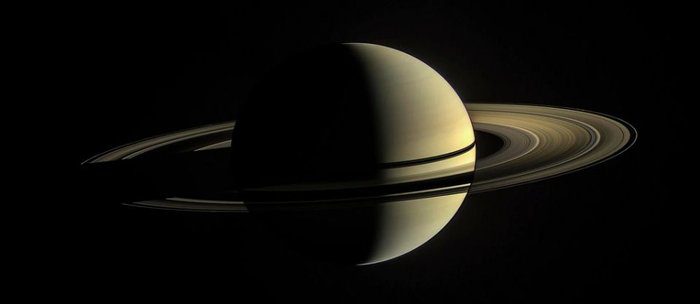
If you look southeast right after sunset, just below the constellation Pisces, you’ll spot Saturn shining in the evening sky. These days, though, it looks a bit different: its famous rings seem to have disappeared.
The reason is that Earth is moving through the plane of Saturn’s rings, making us see them edge-on.
Since the rings are only about 100 meters thick on average, they are nearly invisible, even with strong telescopes. Sometimes, you can only see their faint shadow on the planet.
This event happens in groups roughly every 15 years because of Saturn’s tilted rotational axis, which is at an angle of 26.7 degrees to the ecliptic plane.
As Saturn takes almost 30 years to orbit the Sun, its rings can appear to widen, narrow, or even vanish completely based on our viewing angle.
This same event happened in March, but back then, Saturn was too close to the Sun for us to see it from Earth.
The last time we could see this ring plane crossing was in 1995–1996, and the next one is expected in 2038.
When Galileo looked at Saturn in 1610 with his early telescope, he didn’t realize he was seeing rings and thought the planet had three bodies. Three years later, those ‘three bodies’ lined up into one, which confused him even more. He then thought Saturn had ‘ears.’
The mystery was solved in 1659 when Christian Huygens figured out that they were rings around the planet.


