


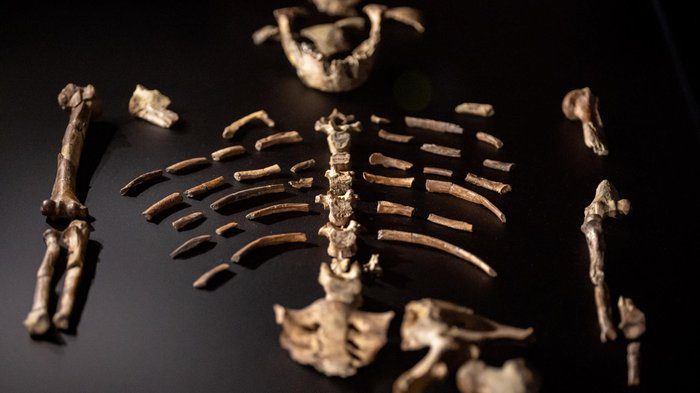
Fossilized foot bones found in Ethiopia’s Afar region in 2009 belong to a second species that lived with ‘Lucy,’ a famous early human. This is according to a new study.
For years, people thought Australopithecus afarensis, Lucy’s species from 3.2 million years ago, was the ancestor of all humans.
But now, we see the human evolutionary tree is more complex and has many branches.
The bones, dated at 3.4 million years old, are called the ‘Burtele foot.’ Yohannes Haile-Selassie, who led the study published in Nature, said, ‘From the first moment, it was clear that this foot did not fit Lucy’s species.’ However, scientists waited for more evidence since naming usually relies on skulls, jaws, and teeth.
Other teeth were found nearby, but it was unclear if they came from the same layer. In 2015, researchers announced the discovery of Australopithecus deyiremeda based on jaws. New findings—including a jaw from a roughly 4.5-year-old child—led them to conclude that the Burtele foot belongs to this species.
This evidence shows that Australopithecus afarensis wasn’t the only human relative around 3.5 to 3.3 million years ago.
The foot of A. deyiremeda has more ‘primitive’ features than Lucy’s. This species could walk upright but still had an opposable big toe, which helped with climbing. It used its second toe for pushing off while walking, unlike Lucy and modern humans who use their big toe. This suggests there were different ways of walking on two legs.
Chemical tests on fossilized teeth show that A. deyiremeda ate leaves and fruits from bushes and trees. In contrast, A. afarensis had a more varied diet that included grasses.
Naomi Levin from the University of Michigan says, ‘During that time, there were many different ways to be human, each with its own advantages.’ It’s still unclear if either species was our direct ancestor or just distant cousins on our evolutionary journey.


