


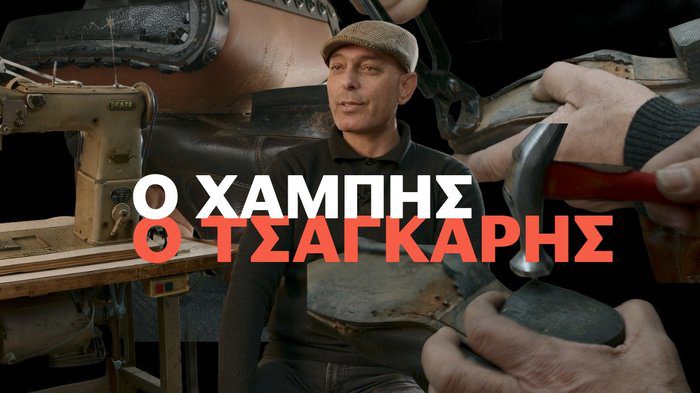
The era and society we live in are characterized by continuous and rapid changes, which no one can dispute. Speaking of professions, it is a fact that in the age of technology, mass production, and fast consumption, many traditional Cypriot professions tend to disappear.
One such profession is that of the cobbler, which for decades was an integral part of daily life.
Meeting Mastre Chambi
Although the role of the cobbler today is limited to shoe repair and not their creation, his knowledge and craftsmanship have not lost their value. One Saturday morning, menoumekypro.com visited a cobbler’s shop in the community of Xylofagou in Larnaca District.
There, we met Mastre Chambi, with his characteristic cap on his head and a smile. Mastre Chambi has been keeping alive an art and at the same time a traditional profession that is slowly fading away. He emphasized that today a cobbler still repairs shoes, but his role has changed compared to the past. Speaking about himself, he does not engage in the classic profession of a cobbler, making a shoe from scratch, but focuses on repairs.
This meeting and interview teach us about an old and beloved profession, discussing its challenges while discovering its value in today’s society through the words of someone who serves it with true dedication and passion.
“If I had known about the cobbler’s profession much earlier, I would have practiced it from a very young age,” he initially states and continues, explaining that he has been involved in the cobbler’s profession for eleven years due to an accident related to his health, which forced him to change professions. “So I chose to do a lighter job.”
The basic tools of a cobbler
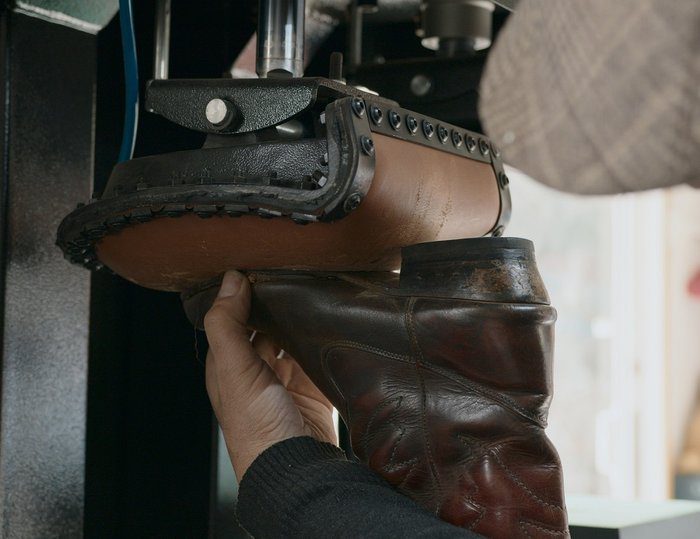
Mastre Chambi explains that the basic tools needed by a cobbler include the barbaya. “Essentially, it’s a tripod on which we place the shoe to repair it, open it, or nail it.” Cobblers also use the falcetta and the montage pliers. These pliers have an extension resembling a hammer, which allows us to grip the leather, pull it, repair it, and nail it using the pliers themselves.
The past and today
Mastre Chambi mentions that in the old days, the cobbler played a significant role in people’s lives. According to him, as is well known, men or women would go to the cobbler’s workshop where he would measure their feet, create a last, and make shoes from scratch tailored to each customer’s needs. He also points out that the cobbler’s profession has almost disappeared and continues to decline as young people do not take up repairing or making shoes. As he explains, most prefer other jobs, mainly office-related ones involving computers and modern technology.
The cobbler must be satisfied and feel fulfilled from the repair he made while feeling even greater joy when the customer receives their shoe and realizes something they thought couldn’t be fixed was repaired,” notes Mastre Chambi
Pushing young people to study the profession
At some point in our discussion, Mastre Chambi suggests that if any young person wants to pursue the cobbler’s profession, it would be good to study as a shoe designer. This way, as he emphasizes, they will be able not only to make repairs but also to create handmade shoes.
The main challenges of the profession
Mastre Chambi notes that one of the main challenges today regarding the profession is when a customer comes and pressures the cobbler to repair their shoe immediately. As he explains, “what the customer asks for often cannot be done immediately.”
He explains that first, the cobbler must examine the shoe, its material, as well as the glue and other materials needed for repair. According to him, repair requires thought and time and cannot be done “in record time,” as glues need sufficient time to dry and act correctly. Additionally, the cobbler must consider whether sewing is necessary.
He further points out that in some cases repair is particularly difficult because there are shoes that must first be opened and disassembled so they can return to their original form before being repaired. Then they must be closed again and shaped as they were so they become functional shoes again. “Afterwards you have to close it again – bring it back as it was – so it becomes a shoe again,” he emphasizes.
Mastre Chambi explains that practicing as a cobbler makes it difficult to expand into another profession. However, he practices this profession out of goodwill and love for his work. Besides being a cobbler, he also repairs watches as well as women’s and travel bags. Basically, he owns sewing machines and has already gained some experience. He repairs whatever he can.</p
Mastre Chambi is an example worth having because he continues the art of cobbling – repairing shoes with the same love and dedication that characterized cobblers of old times.</p
Every pair of shoes he repairs is not just footwear or an object but a small story—a piece of tradition that remains alive without being altered over time.</p
In today’s world of speed and fast pace, Mastre Chambi’s art reminds us that some values are impossible to leave—they simply adapt to continue living within new circumstances.</p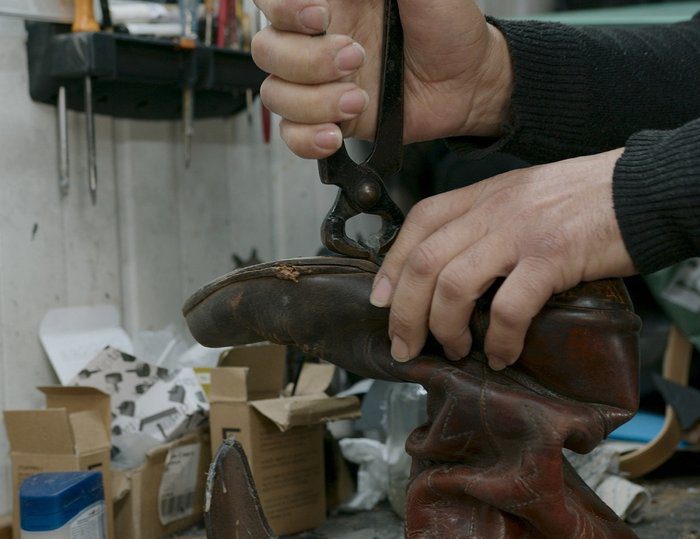
Written by Christina Georgiou


