


A faceless nativity scene reveals hidden truths once again
Listen to what an artist did in Brussels.
Christmas is approaching, and the city’s municipal authority commissioned interior architect Victoria-Maria Geier to create a nativity scene at the Grand Place in Brussels.
And who saw the faithful and wasn’t afraid?
No one. No one in human history has ever seen enraged, offended believers and not been afraid.
But what was it about the creation of a nativity scene that could anger Christians?
The reason is the inclusive approach adopted by Ms. Geier to create the nativity scene.
The work, titled “Les Etoffes de la Nativité” (The Fabrics of Nativity), was deemed an insult to Christian heritage. Instead of the classic depiction, the new nativity is a translucent installation made entirely from recycled fabrics. The figures of Mary, Joseph, the Holy Infant, and others are all faceless. The faces have been replaced by a puzzle of fabrics in shades of beige and brown. According to the design team, the purpose of this choice was to provide an “inclusive combination of all skin tones, so everyone can see themselves.”
And the question is: Who exactly does this approach offend and why?
Why is inclusion less important than what offends the aggrieved believer?

If you belong to a religion that preaches love from human to human and universal acceptance of all people regardless of color, shouldn’t this depiction be considered the most to-the-point? The most representative for a Christian?
Yes, but ultimately no.
The people who belong to the “good” in this scenario, those terribly offended Christians decided to vandalize the work. This happened last Saturday (29/11).
They were outraged by the work that called all people through a symbolic image to feel equal, equally important, and equally represented by the God they believe in.
And they removed Jesus and destroyed part of the rest of the work.
Let’s see who was the first to use a similar “trick” to achieve a more digestible version of Jesus’ image.
The Church itself. Or rather, the Churches. Orthodox, Catholic, and other versions.
When these same entities refer to Mary, who hails from Nazareth and was born in Jerusalem, appearing lily-white with black hair, and similarly Jesus who was born in Bethlehem and grew up in Jerusalem looking German with Scandinavian roots.
This isn’t an attempt aimed at serving the “charm” of the figure to attract more believers?
This isn’t an attempt for Europeans to feel closer to Jesus’ image so they feel he is one of them?
In conclusion, wasn’t this actually the most classic case of insulting Christian heritage when we altered his features and turned them into more “acceptable” ones for our tastes? We presented a Middle Easterner with Swedish features?
I suspect those offended by the Belgian artist’s work will be the same ones annoyed by this statement here. Because offense is a very convenient choice to proclaim our faith’s magnitude when deep down we feel we aren’t really that good Christians.
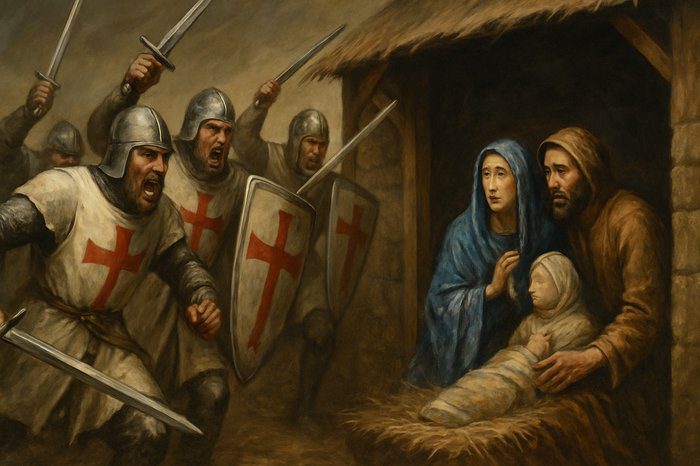
What might be closer to what people claim they represent would be focusing on being people alongside people, regardless of religion and color, not soldiers – defenders, members of an army fighting for their truth against another army’s truth.
Guess whose side Christ would “fight” on if he lived today?
With Ms. Geier who envisioned her work as a “mosaic” from small pieces representing all people’s appearances or with those offended who raised their “spears” and vandalized a nativity scene? Because it was a… different nativity scene.
Papa – Ratsis


