


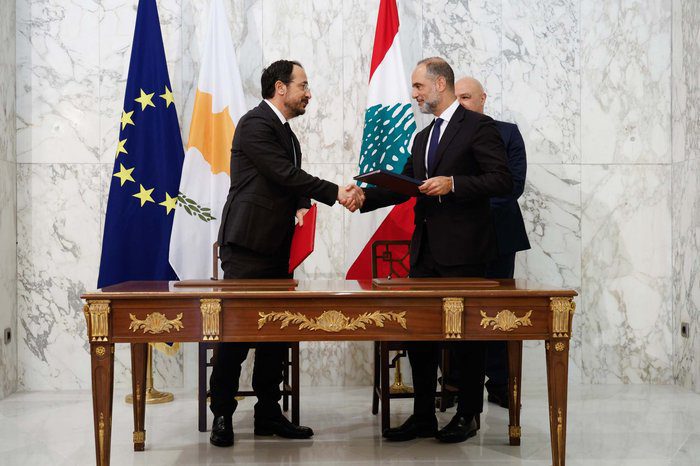
President Nikos Christodoulides’ visit to Beirut and the signing of two key agreements with Lebanon’s President, Joseph Aoun, are more than just another diplomatic event for Nicosia. They mark a significant shift in the region’s geopolitics, impacting power dynamics and boosting Cyprus’s presence in a turbulent area.
For 18 years, the agreement on the EEZ between Cyprus and Lebanon was stuck due to political issues and Turkish pressure on Lebanese governments. Nicosia knew this well, which is why it kept its plans secret until the last moment. The signing in Beirut isn’t just a typical bilateral deal. It’s the result of hard diplomatic work, changing circumstances, and a new geopolitical reality in the Eastern Mediterranean.
The EEZ agreement not only settles a long-standing issue but also paves the way for future agreements with Syria if Nicosia and Beirut cooperate. This change disrupts Turkish plans and curbs Ankara’s efforts to push its own agenda in the maritime area with its ‘Blue Homeland’ ideology. By aligning Lebanon with proper maritime boundaries, Cyprus strengthens legal claims in the Eastern Mediterranean.
Meanwhile, the electrical connection between Cyprus and Lebanon, the second agreement signed, is significant for two reasons. First, it provides Lebanon with a chance for energy stability in a country where electricity supply is often unreliable. Second, it positions Cyprus as an energy hub and a source of European expertise in the region. The World Bank’s involvement in studies and interest from Gulf countries for funding show that this initiative has international potential.
The importance of these agreements is clear from strong US support. Lebanon is crucial for Western interests in the Middle East, especially after recent crises. Washington believes this agreement boosts President Aoun, stabilizes Lebanon, and limits Hezbollah’s influence. It also keeps the door open for American energy interests in future explorations across both EEZs.
The EU is also sending strong signals. The release of half a billion euros to Lebanon, new European projects, and the Cypriot Presidency in 2026 make Cyprus a key link between Europe and Lebanon. Nicosia aims to strengthen ties before taking over the Presidency to secure a broader EU-Lebanon strategic agreement.
An important part of this is the agreement to bolster Lebanese armed forces. Cyprus, along with the EU, actively supports Lebanon’s stability. This fragile yet vital country is crucial for maintaining balance in the region.
The current situation shows that Cyprus is building a multi-faceted relationship with Lebanon—energy-focused, political, European, and even defensive. Christodoulides’ visit to Beirut and the signed agreements are not just fleeting actions. They are part of a larger strategy for Cyprus to be a stable force in an unpredictable geopolitical landscape.
As balances shift, Cyprus appears to be seizing opportunities, forming alliances, and enhancing its regional role. For a small country, this could be its most powerful asset.


