


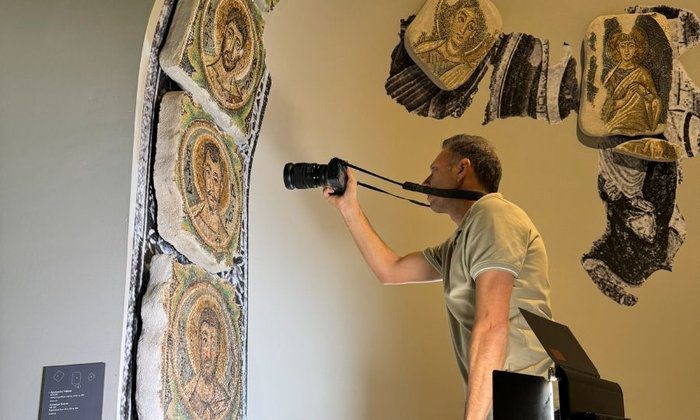
Frederick University is excited to join the research program ‘Documentation, Promotion, and Replication of Mosaics from Ecclesiastical and Other High Cultural Value Sites’ (MOSAIC). This groundbreaking initiative focuses on preserving and documenting cultural heritage. It works in partnership with the Technical University of Crete, the Byzantine Museum of the Archbishop Makarios III Foundation, and the Department of Antiquities of the Deputy Ministry of Culture.
A team of key researchers from Frederick University is involved, including Professor Antonios Londos, Professor George Demosthenous, Professor Kostas Kyriakou, Professor Sotiris Omirou, and Mechanical Engineering graduate Mr. Demosthenis Vambourellis.
MOSAIC is the first program designed specifically for Byzantine mosaics. It will start with digital documentation using special algorithms and artificial intelligence. Then, molds will be created through micro-processing on special materials to produce accurate replicas of the mosaics in various sizes.
This method ensures precise recording of the shape, texture, and color shades of the mosaics. It greatly aids in preserving and documenting Byzantine art. The replicas can be used for education and exhibitions, providing a fresh way to study and display mosaics.
The main goal of the project is to create and improve a complete process for digitally documenting and reproducing Byzantine mosaics. To achieve this, advanced digital technologies and modern equipment will be used, both existing and new ones acquired through project funding.
Professor Antonios Londos from the Mechanical Engineering Department explains that this process allows for very detailed documentation of wear, cracks, and color changes. This way, works can be digitally preserved if originals are lost or damaged. The program also blends traditional techniques with modern technologies like artificial intelligence, creating an innovative approach that could be applied to similar projects abroad.
The project is funded 80% by the European Regional Development Fund and 20% by national resources from Greece and Cyprus under the INTERREG VI-A ‘Greece–Cyprus 2021–2027’ Cooperation Program.


