






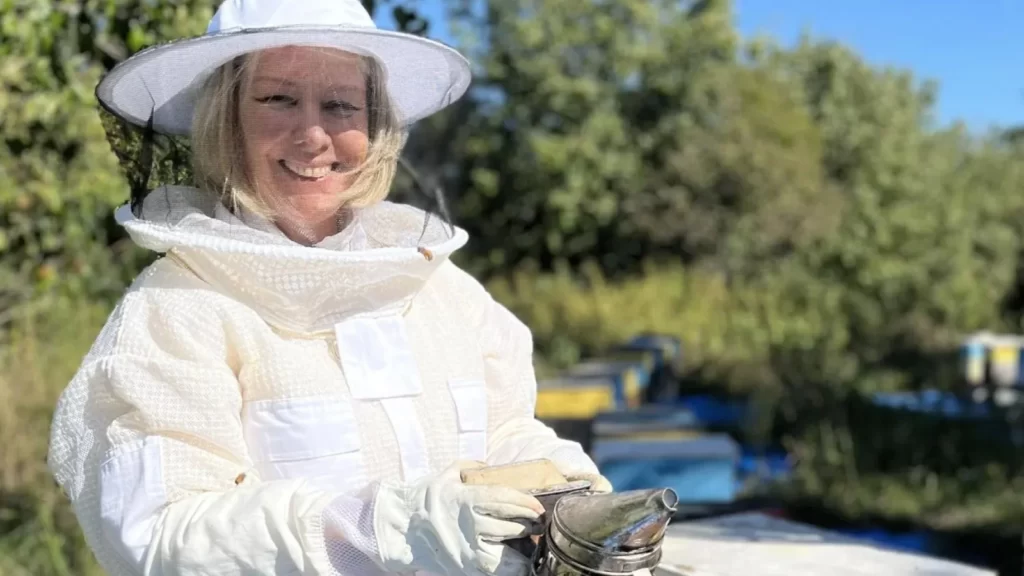
Dalan Animal Health founders Annette Kleiser and Dalial Freitak have figured out how to vaccinate honeybees against diseases that wipe out up to half the hives in the U.S. each year. Vaccines for shrimp and mosquitoes are on the horizon
How do you vaccinate honeybees? And would such a thing even be of interest to beekeepers?
These are questions that Annette Kleiser has been battling over since the establishment of Dalan Animal Health in 2018. In the sixth year of the venture, the government approved an oral vaccine that the team developed for beekeepers around the world to feed to worker bees. Through them, the drug then reaches the female bees in the form of royal jelly. The result, oddly enough, is that her offspring become innately immune. Now Klaizer has set herself the goal of vaccinating as many bees as possible and thereby saving not only the hives, but also the crops they pollinate.
We know that the loss of bees is very critical for the environment,” says the entrepreneur. – We can’t survive without insects on Earth or anywhere else”.
The proprietary vaccine protects against the dreaded bacterial disease aptly named “American rot,” and Kliser sees the development as the first step toward curing the estimated 3 million bee colonies in the United States.
In bees, this disease is not unique. A variety of ailments, including voracious parasitic mites of the genus Varroa, pesticide poisoning, improper feeding and the stress of traveling across the country to pollinate crops, kill about 50 percent of colonies and millions of individuals each year. For beekeepers, the numbers are horrifying. “Imagine a livestock owner losing 30-50% of their livestock each year,” compares Matt Mulica, senior project director at the Keystone Policy Center, which coordinates the Honey Bee Health Coalition. – How do we fight this?”
Klizer, along with staff at Dalan Animal Health in Athens, GA, believes that an important tool to preserve bee populations is a vaccine specifically designed for them. The drug would allow commercial beekeepers (they keep 5,000 to 30,000 colonies) to further drive bees around the country to pollinate crops like almonds, blueberries, cucumbers and apples.
“If you have an outbreak [of American rot], the spores are so tenacious that the recommended treatment is to kill all the bees and burn every hive,” explains Tom Chee, founder of At One Ventures, which provided funding for Dalan Animal Health in a seed round in the summer of 2022 (at the time, the startup was conducting clinical trials for an American rot vaccine, and the business was valued at $3.6 million). – If it gets picked up, it’s a total disaster.”
Kleiser has a degree in neurophysiology and studied at the Ludwig and Maximilian University of Munich. The woman learned about the research that later led her to bee vaccines when she began helping universities translate academic research into commercialization. During a visit to the University of Helsinki, she met Dalial Freitak, an Estonian biologist and zoologist. Her colleague had a non-trivial idea: what if deactivated bacteria were injected into the bees to increase the hive’s resistance to disease? Insects and other invertebrates don’t have the antibodies that humans and other mammals have, so the traditional way of creating a vaccine wouldn’t work on them. “When I heard about the research, I thought, why isn’t anyone doing this?” – Klizer recalls.
The entrepreneur took Freitak’s work beyond the university and created a vaccine that is added to what’s called uterine nectar for worker bees. They then make royal jelly from it and feed it to the uterus. As a result, the emerging larvae will be more resistant to the disease.
Beekeepers are watching closely. “This is something new. That’s probably why there’s so much attention and excitement,” says Blake Shook, a commercial beekeeper from Leonard, Texas, who is testing the new vaccine. Government customers are also interested: Klizer says she is talking to authorities in several Asian, South American and European countries (the founder declines to name them) about potential purchases to protect the bee population. So far, the entrepreneur has raised $14 million from At One Ventures and Prime Movers Lab. Although the startup is still at an early stage of development and its revenue does not exceed $1 million, the founder is optimistic that next year she will be able to sign major contracts with both governments and commercial beekeepers.
But a major hurdle remains: beekeepers need to be convinced that the $10-per-dose price tag is justified. “Everyone is interested,” Shook says. – But it’s expensive, and beekeeping is not a high margin industry.”
Russell Heitkam, whose Heitkam’s Honey Bees is a large supplier of honey bees (the company sells about 75,000 each year), says his clients struggle to understand the economics and pricing of vaccines. For commercial beekeepers with 30,000 hives, the cost of vaccination at $10 per bee-mate skyrockets to about $300,000. With Dalan Animal Health, Heitkam is collaborating on a vaccine trial. He wants to see evidence that the drug can increase the proportion of healthy insects in each colony, which in turn will produce more honey and pollinate more plants. The drug’s developer says the cost of the vaccine is more than offset by lower bee mortality and better health, but Heitkam and other beekeepers want the vaccine to protect against more than just American rot, because industry players are partly able to prevent it by improving the beekeeping process, such as not using the same equipment in different colonies and thoroughly cleaning hive tools.
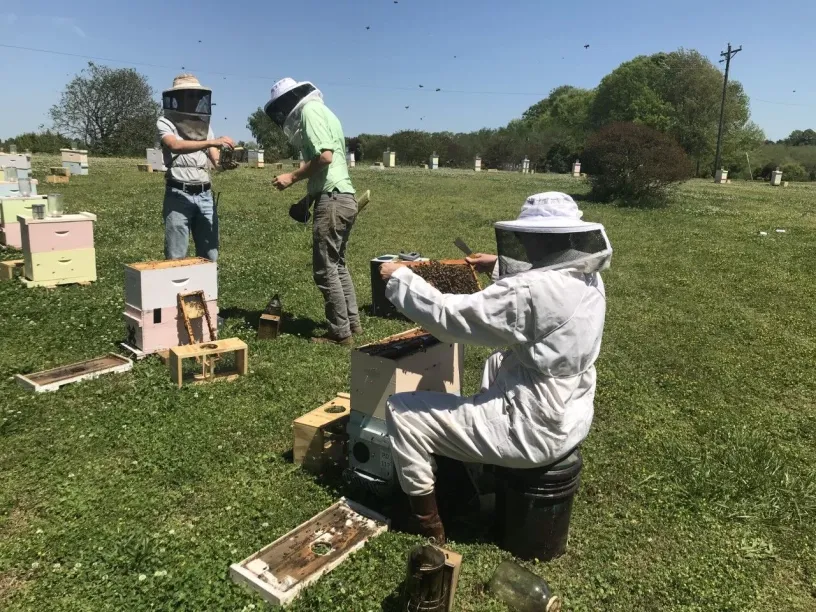
Foto Dalan Animal Health
“People call me and say, ‘I want to buy bee breeders, do they need to be vaccinated?”‘ – says the businessman. – On average, a queen costs $28, and now you want to add another $10 on top, so that $10 has to pay for itself somehow.
But the businessman emphasizes: “If their vaccine gives an extra frame of bees during pollination, the investment will pay for itself, in and of itself.” A frame is a removable part of a hive that typically holds 2,000-2,500 individuals.
Chris Hiatt, commercial beekeeper with Hiatt Honey and part-time president of the American Honey Producers Association, adds: “Word of mouth is very strong in beekeeping. If someone cuts their winter losses in half by vaccinating their queens, everyone will know about it instantly.
And we’re only talking about one bee disease here. Researchers at Dalan Animal Health are trying to determine if the vaccine can protect against the others, especially one extremely harmful one called wing deformity virus. So far, experimental trials in 400 commercial hives have shown that the rate of spread of the highly contagious variant of the virus has been reduced by 83%. “Effective treatment is considered effective at any rate above 65-70%, and we have already exceeded that,” notes investor Chi.
The next step will be to move from honeybees to other invertebrates, shrimp for starters. “It was clear to me from day one that this was not going to be a solution for one single insect, but in the long run for all invertebrates,” explains Freitak, the company’s scientific co-founder.
Like beekeeping, the shrimp farming industry – a market, by the way, estimated at $40 billion – suffers tens of percent annual losses due to disease, despite even the heavy use of chemical pesticides, which are also highly damaging to the environment. “The losses are in the billions, with shrimp production increasing and the industry itself having a tremendous impact on mangroves because of the chemical agents it uses,” Klizer reasoned.
Since the immune systems of shrimp and bees are similar, the entrepreneur believes Dalan Animal Health can vaccinate the mothers of sea creatures in much the same way as bee mothers. The company has initiated trials of vaccines against a disease common among shrimp known as white spot syndrome virus, first on small shrimp and then on larger shrimp already suitable for commercialization. The firm says it is seeing the first promising results, with a survival rate of 64% in initial trials at an aquaculture research facility. “In the case of shrimp, all ventures have failed,” states the startup’s CEO. – “We think our approach is so different from the others that there is a real chance to penetrate this market.
If a vaccine works on bees and shrimp, what else can it do? In the long term, Klizer is convinced that even mosquitoes that transmit diseases like malaria and dengue fever to humans could be vaccinated, making outbreaks around the world far less frequent. As the risks of formerly strictly tropical diseases spreading northward with climate change increase, the ability to vaccinate insects could eventually prove as important to public health as it is to food security.
“It’s already much more complicated than honeybees,” says the startup leader. – Bees are important because we need them to survive, but the science behind it is much more serious.
News source forbes.ru The information is used within the framework of fair use of content and is not used for commercial gain.