


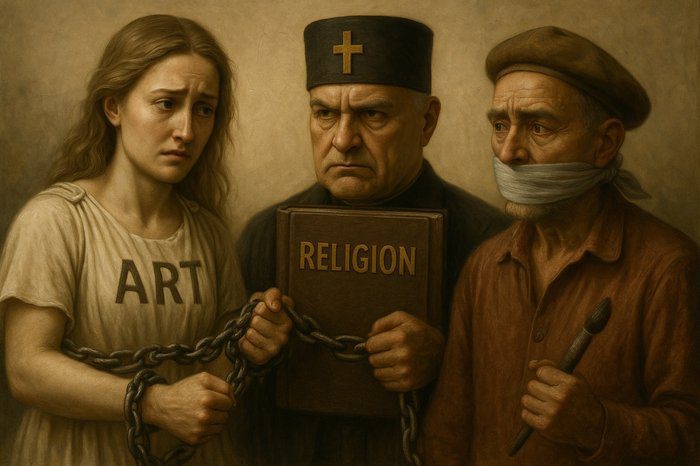
We’ve said it before, and we’ll say it again: the idea of offense is silly. It’s an unfounded rule that sets limits whenever it’s convenient. Offense is a powerful tool for those who think they know the truth of their beliefs.
If you hit someone on the head with a club, you’ll hurt them. You might even kill them. This has nothing to do with how some people feel offended. Here’s what offense looks like:
A person holds a club and swings it around. You go and put your head under it, then you cry out in pain.
— Why are you acting like this?
— He hit me with the club.
— But he didn’t hit you; you stepped into the way of the club.
— YOU DON’T UNDERSTAND: HE’S NOT ALLOWED TO HOLD A CLUB.
This is offense. It took me a lot of words to explain this so that the next part is clearer:
An artist planned an exhibition at a gallery.
We won’t get distracted from what’s important. We don’t care if we find his works beautiful, masterpieces, ugly, or just a waste of paint. Whether we like them or not is a different discussion for another time.
This man, Giorgos Gavriil, is a painter and an artist. Like all artists, he has the right to express himself through his art, NO MATTER what it’s about, UNLESS he uses art to spread hate, incite violence, or harm someone.
I feel uneasy that these explanations are needed. I feel uncomfortable, numb, very troubled, and — once again — disappointed. ‘Angry’ comes last.
Once again, part of society showed its disgust on social media for Mr. Gavriil’s works because they touch on religious, political, and social issues. But what mainly bothers them are the religious themes.
You know what? This group of our fellow citizens has every right to express their feelings. If they don’t like the artist’s style and think his works are ugly, they can say so.
Yes, some comments on social media aren’t constructive or polite. But who are we to limit people’s criticism? Are we going to STOP people from expressing themselves? NO, of course not.
I won’t mention the curses wishing death and illness upon the artist in this week’s critique but will save that for something deeper and sadder. Yet again: what can you do? Can we teach empathy and education to everyone? It’s not possible.
HOWEVER: there’s a big difference between criticizing an artist’s work and demanding to cancel his exhibition because it ‘offends’ you and your religion. That difference smells of fascism from far away.
The vice president of DISY led the outrage: he called the work ‘blatant blasphemy’ and blamed not just the artist but also those showing it (the gallery) and those supporting it (the audience). NOTICE: it’s not just the creator being accused but also the viewer. This is classic guilt-tripping along with spreading fear.
Does this remind you of anything? The bones of past ‘patriots’ in many countries — including Greece — who burned books in public must be rattling with satisfaction.
Next came ELAM (of course), the President of Parliament, DIKO, Mayor Faidonos of Paphos, and others.
And here’s the key point:
What did all these people ask for? Did they just say they wouldn’t visit the exhibition because they found it tasteless or unartistic? No. They demanded that it not happen at all.
And so it happened. The exhibition was canceled because some were offended. In a secular state where religion should be personal, we show once again how close we are to regimes where freedoms aren’t guaranteed and rules are set by someone’s god.
The Blue Iris Gallery canceled the exhibition. It’s hard to believe they only learned about its content yesterday. They knew. But they gave in to pressure and vague threats from the surrounding atmosphere.
They also issued an apology if anyone was offended, saying that wasn’t their intention and that they don’t want to create more tension.
And we find ourselves once more as spectators of this same old story — for centuries now.
Art was never meant to comfort faith. Art exists to challenge certainty. And for that, it needs space to breathe, not cloths soaked in chloroform to stifle it.
Faith can’t demand censorship by nature. When faith demands censorship, it turns into authority. And faith with authority can’t coexist — don’t you think?
If there had to be a limit on an artist’s freedom somewhere, it’s not in offended feelings but where violence begins. (Some people’s feelings here have much more serious reasons to be offended.)
If we ban an exhibition because we dislike what its creator makes, this act doesn’t protect values; it reveals insecurities.
No one forces anyone to visit Gavriil’s gallery and see his works. But for those who don’t want to go, that’s not enough: they want others not to go either.
And let me ask once more:
Does all this remind you of anything?
Papa – Ratses


