


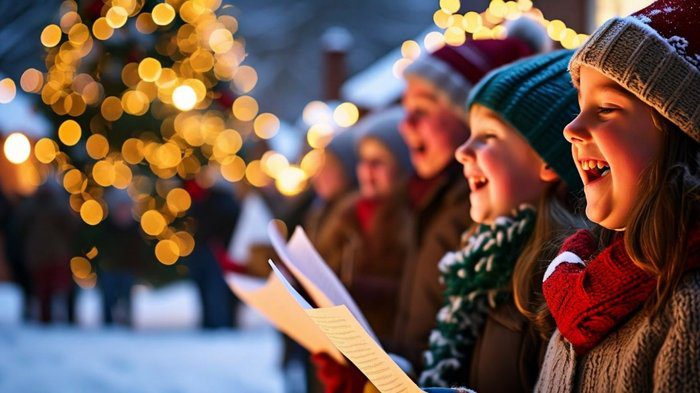
Shall we sing them? Or rather, can we sing… what remains?
Carols.
They came to our house on Christmas Eve morning, a little boy and a girl. Probably siblings. They sang for us, and across the street, a man was waiting. Probably their father, watching them with pride. That was it. No other children came. I asked my daughter because I left for work afterward.
Did any other children come?
No.
It’s a shame… and as soon as I said ‘it’s a shame,’ I realized that my own daughter has never sung carols and now (since she’s nearing 15, there’s probably no chance for that to change).
Written by Papa–Ratsis
There was a time—not so long ago, but long enough to seem like an urban myth—when caroling was a collective affair. Groups of children, from the early morning hours, with triangles jingling crookedly, voices entering wherever they could, and a sincere eagerness: to sing carols, flooded the streets.
Not just for the money (of course for that too), but mainly because it was a seasonal joy. It was an outing for the kids, it was playtime, it was a small neighborhood adventure.
Back then, children rang doorbells with such enthusiasm that they didn’t even think about the ‘scoldings’ that awaited. Today they ring them as if doing an internship. Bang-bang, half carols if any, hand extended, a half-hearted thank you too, and off to the next apartment. Without eye contact, without a smile, without the slightest sense that what’s happening has even a hint of festivity. Like civil servants who didn’t come voluntarily but were summoned by us during festive days for some malfunction: You see more weariness in their eyes than celebration.
Last year I witnessed the ultimate innovation adapted to our era’s DNA: the first playback carols. Kids with portable speakers played the carols normally—in studio quality—and they murmured along with whatever lyrics they remembered.
And all this WHEN and IF you find kids singing carols.
You now find sea turtles or White Tigers in Egypt more easily. The children who go out are few to ‘endangered species.’ Next year perhaps WWF or ARCTUROS will intervene to protect the remaining ones.
And those who do go out rarely do so alone. Behind them—or beside them, like Kevin Costner bodyguards—is usually a parent. Which I can’t blame them for. Because as if everything else wasn’t enough, in recent years there have been increasing incidents where children singing carols felt like exhibits at the Louvre. Like the mint in Casa De Papel. People find it a good idea to rob kids going out to sing carols.
The most awkward aspect of the new customs and traditions of caroling is: Adults. Groups of adults singing carols. This image is as strange as seeing a group of children performing open-heart surgery at a university hospital. Adults singing carols is an incongruous image, almost awkward, surrealistic. Carols were a tradition featuring children’s faces; when you see thirty-somethings doing it, it’s like watching a children’s choir made up of retirees.
Yet, as bizarre as this image may seem, behind it lies another picture. A social X-ray. With findings of financial difficulty, need, poverty. When someone goes out to sing carols not for tradition but to supplement income, the joke cuts short. Only awkwardness remains and a bitter truth knocking on the door.
Shall we sing them?
…
Perhaps in the end carols haven’t disappeared. They’ve just grown awkwardly, modernized wrongly and we’ve burdened them with more than they could bear. And every time we hear that faint ‘shall we sing them?’, we don’t just long for our childhood years. We long for a time when carols ‘went out’ and roamed neighborhoods with joy—not out of necessity, not with fear, not in playback.


