


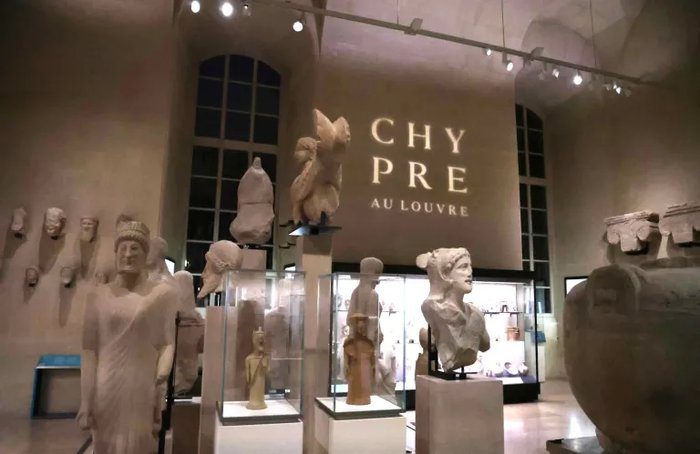
The exhibition titled “Cyprus at the Louvre” continues until June 22 at the Louvre Museum in Paris, within the framework of the Cyprus Presidency of the Council of the European Union.
According to an announcement by the University of Cyprus, “Cypriot antiquities that have been hosted at the Louvre since the 19th century have come, as of last Tuesday, February 10, and until June 22, 2026, into an open dialogue with 16 Cypriot antiquities made of copper, clay, and marble. These cover a vast chronological spectrum, from the so-called Chalcolithic period (approx. 4000-2500 BC) to Roman times (approx. 200 AD), and were transported to Paris for the exhibition from various Cypriot museums.”
Indicative examples include two cruciform idols made of picrolite, masterpieces of ancient Cypriot art, and a fragment of a copper ingot from the Late Bronze Age (approx. 1650-1100 BC), which serves as a reminder of the extensive export of this Cypriot metal across a vast geographical area, from Egypt to the Aegean and the Black Sea, and from Mesopotamia to modern-day France and Germany.
“The exhibition also presents two of the approximately 2,000 terracotta warrior figurines from the Sanctuary of a male deity, possibly Apollo, excavated near the occupied village of Ayia Irini in the Morphou Bay (approx. 1200-500 BC), as well as four delicate bronze surgical tools belonging to an anonymous Cypriot doctor, dating to around 200 BC, which are displayed next to a marble figure of Asclepius from Paphos,” the announcement notes.
“To honor the host country, the exhibition also presents the invaluable contribution of French archaeological research and excavations in Cyprus, from the 19th century to the present day, highlighting the bonds between the two countries,” it adds.
Of great interest is the use of innovative digital technologies in this exhibition, bringing both ancient and modern Cypriot culture to life. Visitors are invited to explore the world of Cyprus through their mobile phones and tablets, via 3D representations, interactive screens, and augmented reality experiences activated on-site using QR codes.
It is highlighted that “with the help of digital technologies and a phone, the stone statues and clay figurines hosted at the Louvre acquire a voice and movement.” Poetry inspired by the island and its people, both ancient and modern, as well as well-known traditional Cypriot songs that have echoed in Cyprus for centuries, can be heard through visitors’ mobile phones (via QR codes placed in prominent positions next to the exhibits).
“Poems by George Seferis, who was inspired by Cyprus to write some of his most significant works, the so-called ‘Cypriot Poems’ (Engomi, Helen, Salamis in Cyprus, In the outskirts of Kyrenia…), are ‘recited’ by statues from the 6th and 5th centuries BC,” the report states. “Another statue recites poems by Constantine P. Cavafy and Costas Montis, which revolve around the universality of the Greek language.” The poems are heard in three languages: Greek, French, and English—the entire exhibition is presented in these three languages as well.
It is also the first time that traditional Cypriot music and songs, such as “Jasemi,” “Arodafnousa,” “Tillyrkoutissa,” “Acherobasman,” and others, are heard within the halls of the Louvre. Two 3,500-year-old clay figurines depicting women holding babies in their arms sing “Agia Marina tzai Kyra,” while two clay warriors from the ancient sanctuary in Ayia Irini of Morphou sing “Tessera tzai tessera.” The songs were recorded specifically for the exhibition by the Amalgamation women’s polyphonic choir.
The exhibition is accompanied by a 180-page catalog with rich iconographic material and brief accompanying texts, available free of charge to everyone in the exhibition’s three languages via the Presidency’s website and the Louvre’s website. In the same context, three lectures are scheduled at the Louvre: a presentation of the exhibition on March 19, a lecture on medicine in ancient Cyprus on March 25, and a third dedicated to Salamis on April 1, 2026.
The exhibition is organized by the Deputy Ministry of Culture of the Republic of Cyprus and the Louvre Museum, in collaboration with the University of Cyprus and the CYENS Centre of Excellence.


